
August 2026 Bank of Korea Base Rate Outlook
The Bank of Korea's Monetary Policy Board is likely to hold the Base Rate at the current 2.75% on August 27, 2026
Introduction
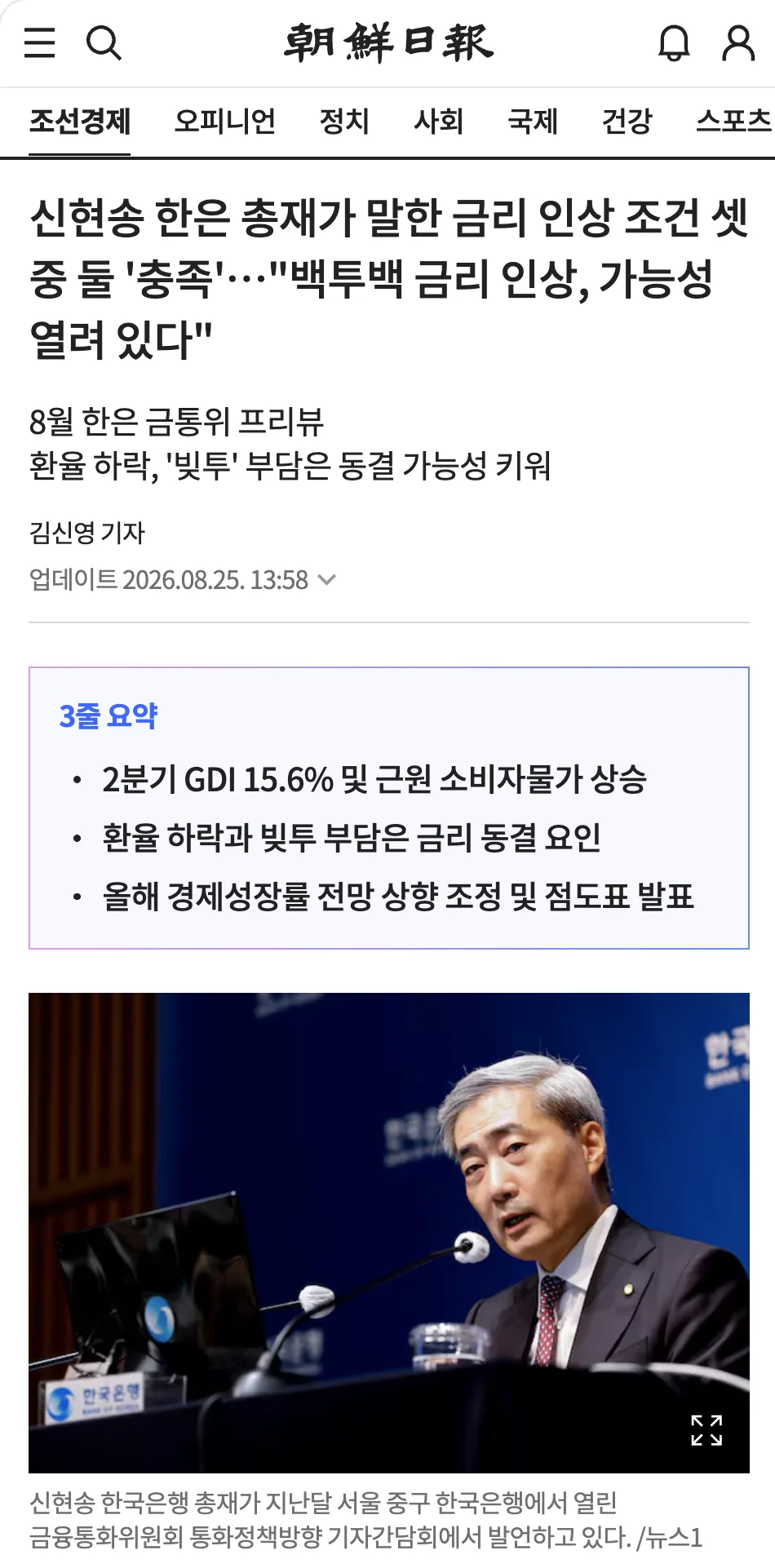
Governor Hyun Song Shin, who took office at the Bank of Korea in April 2026, raised the Base Rate by 0.25%p in July 2026, from 2.50% to 2.75%. It was the first hike in three and a half years.
Listening to Governor Shin and several Monetary Policy Board members, whose language has stayed consistently close to hawkish, another 0.25%p hike in August 2026 seems all but certain.
KRED, however, sees that as unlikely. We think the Bank of Korea is more likely to hold the Base Rate at 2.75% in August 2026.
Prices
Bank of Korea Act
Article 1 (Purpose)
(1) The purpose of this Act is to establish the Bank of Korea and, through the formulation and implementation of efficient monetary and credit policies, to pursue price stability, thereby contributing to the sound development of the national economy.
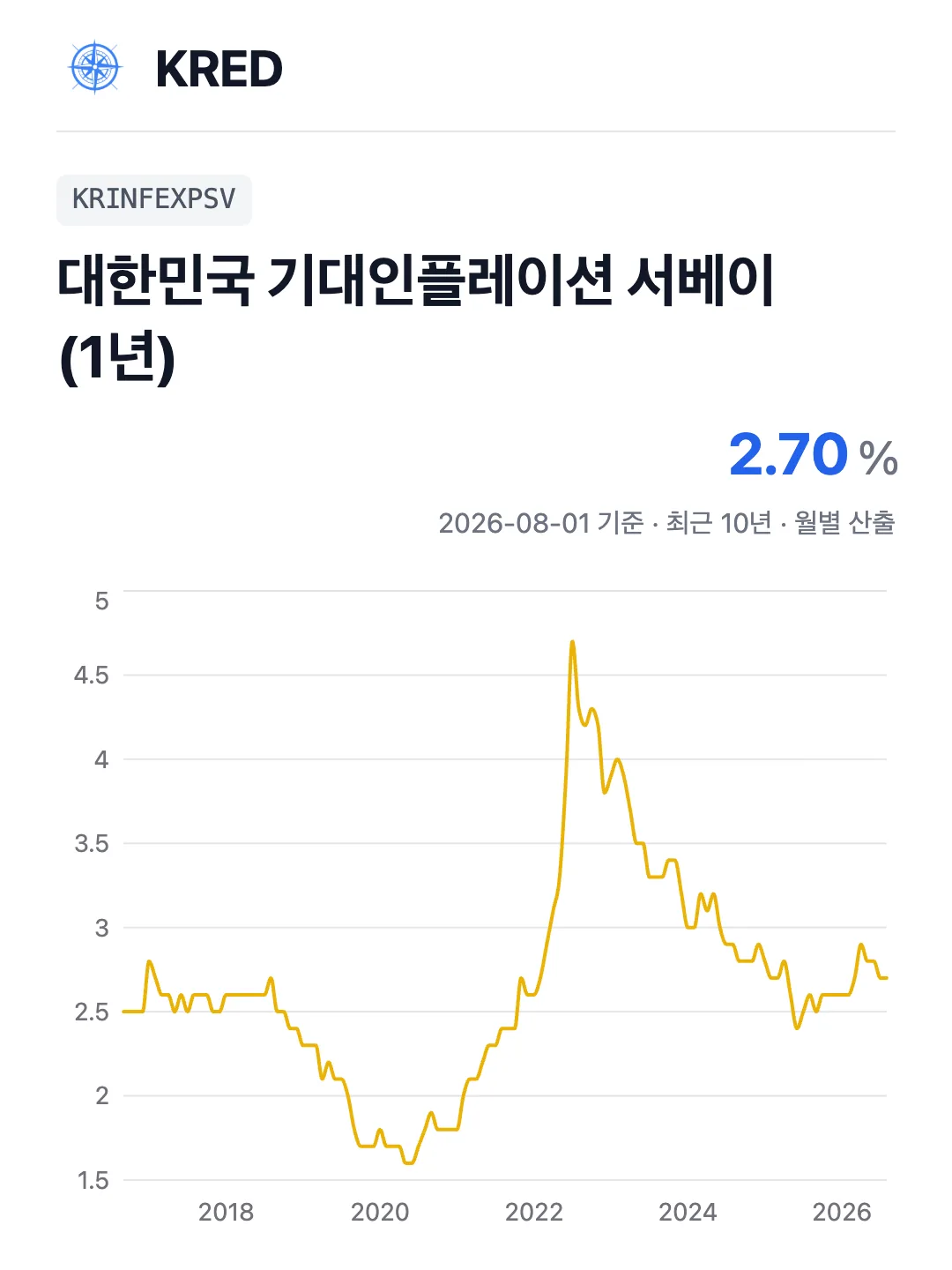
The Bank of Korea's first mandate is price stability. Reading the price indicators together, though, the Bank appears set to pursue price stability by restraining inflation expectations.
Inflation expectations are the forecasts economic agents such as firms and consumers hold about how much prices will rise from here. When that number runs high, it feeds into wage demands and product prices, a loop that can end up stoking actual inflation.
Put differently, a central bank that successfully restrains inflation expectations can pursue price stability while minimizing the pain a rate hike inflicts on households and firms, such as heavier loan repayments.
https://kred.dev/en/series/KRINFEXPSV
At present, inflation expectations have been falling for months since forming a near-term peak in April 2026. That gives the central bank reason to pin its price-stability hopes on expectations and keep watching this gauge.
The central bank will therefore deliberately keep giving economic agents the impression that further hikes are coming. Doing so restrains inflation expectations and delivers much of the price-stability effect of an actual hike without one.
https://kred.dev/en/series/KRTRINF
Under the Bank of Korea Act, the Bank runs an inflation-targeting regime aimed at 2% annual inflation over the medium term.
Bank of Korea Act
Article 6 (Formulation of the Direction of Monetary and Credit Policies, etc.)
(1) The Bank of Korea shall, in consultation with the Government, set the price stability target.
[...]
(3) With respect to the target under paragraph (1), the Bank of Korea shall do its utmost to attain the price stability target.
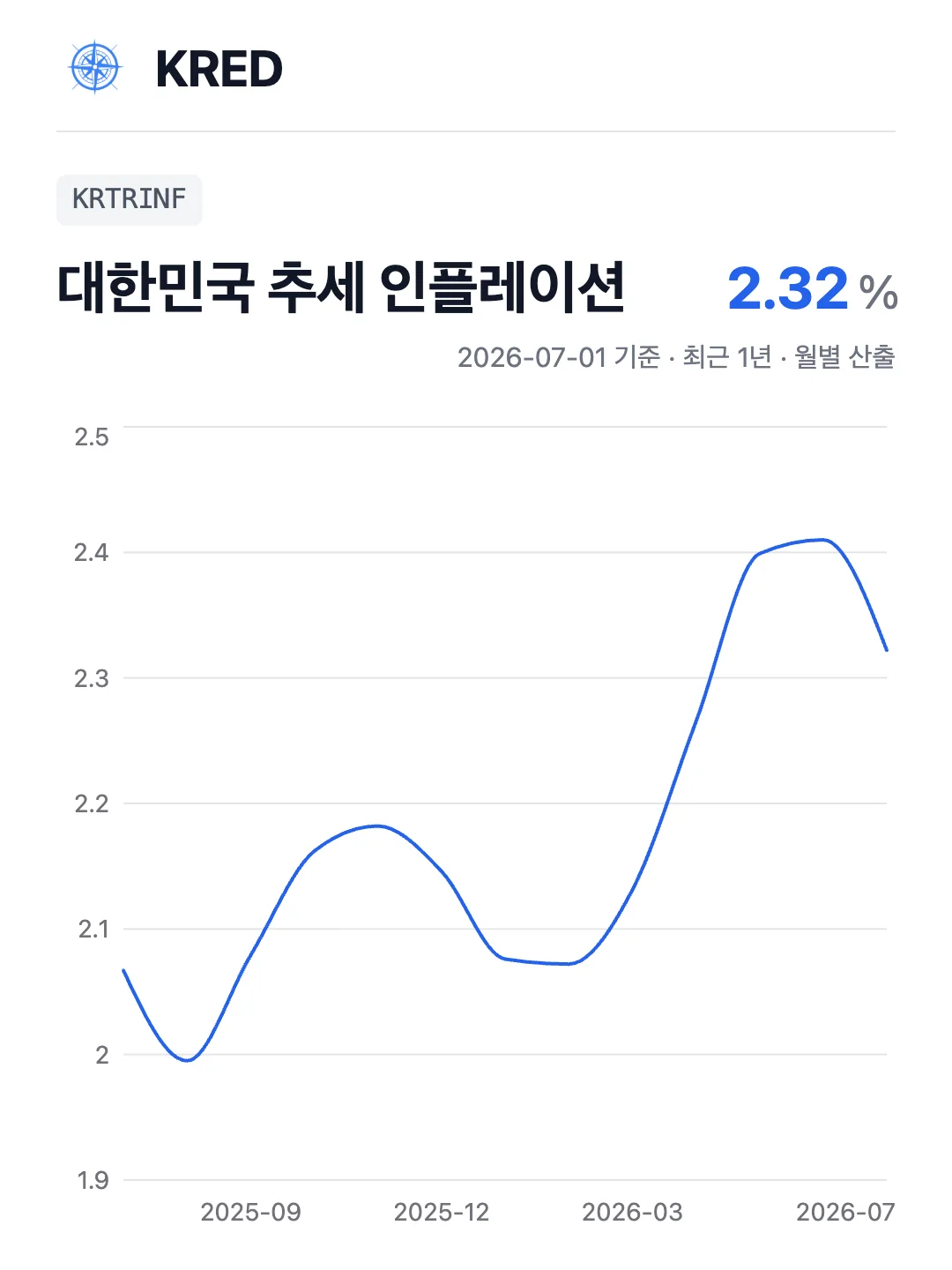
Headline inflation as measured in the market, however, whipsaws with the exchange rate and commodity prices. So the Bank of Korea uses econometric models to strip transitory shocks and noise, such as oil and the won, out of headline inflation and extract the slow-moving underlying component.
This is trend inflation, the steady-state value toward which inflation converges over the medium to long run.
Fortunately, trend inflation has also been falling since printing 2.41% in June 2026. If the Bank steers this gauge back to 2%, it will have tamed inflation. Should growth hold up along the way, Korea could be looking at a low-inflation, high-growth Goldilocks.
Growth
https://kred.dev/en/series/KRRECP
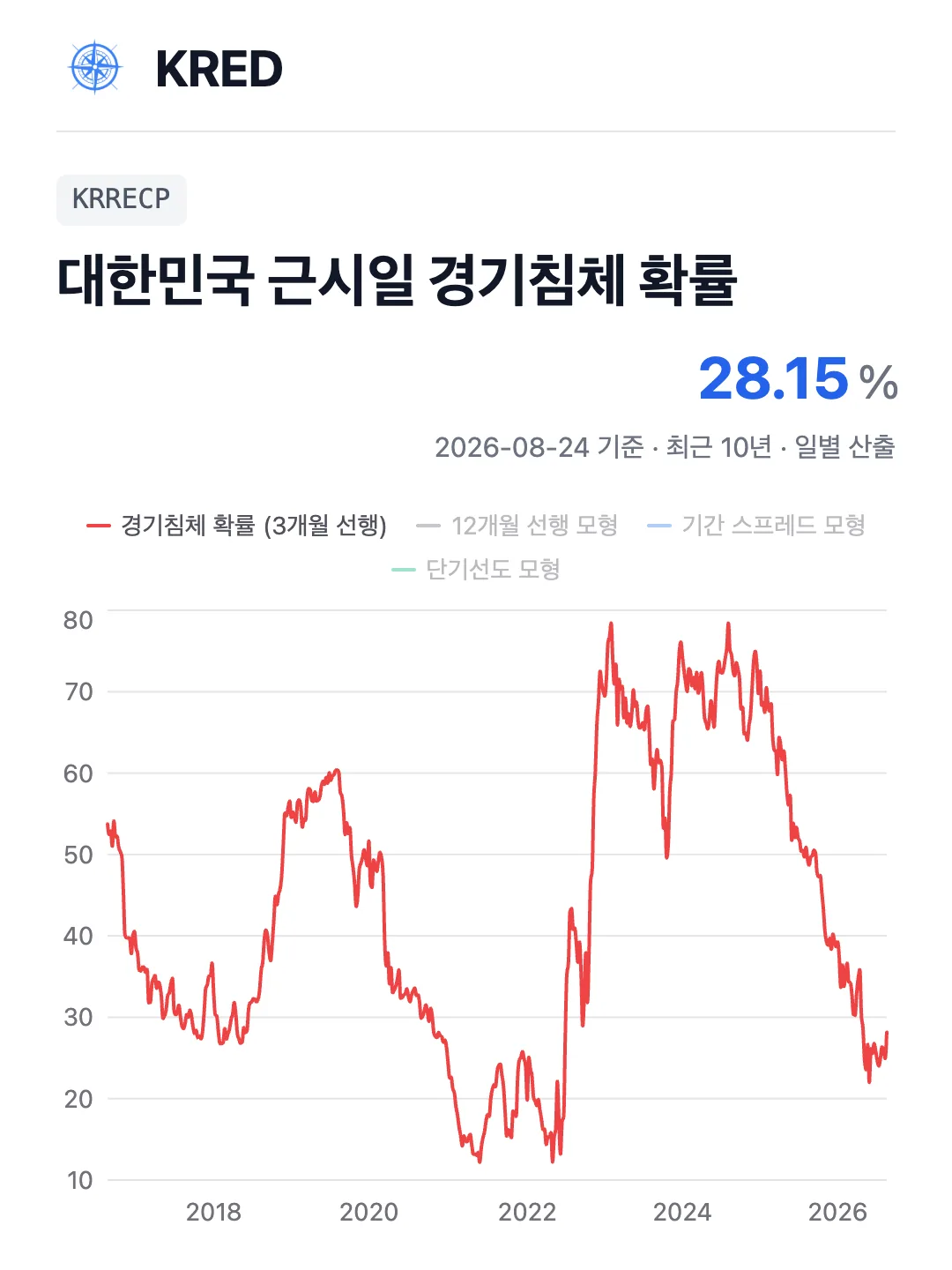
The Korean economy is in an unmistakable expansion. The probability of a recession within three months can safely be read as zero.
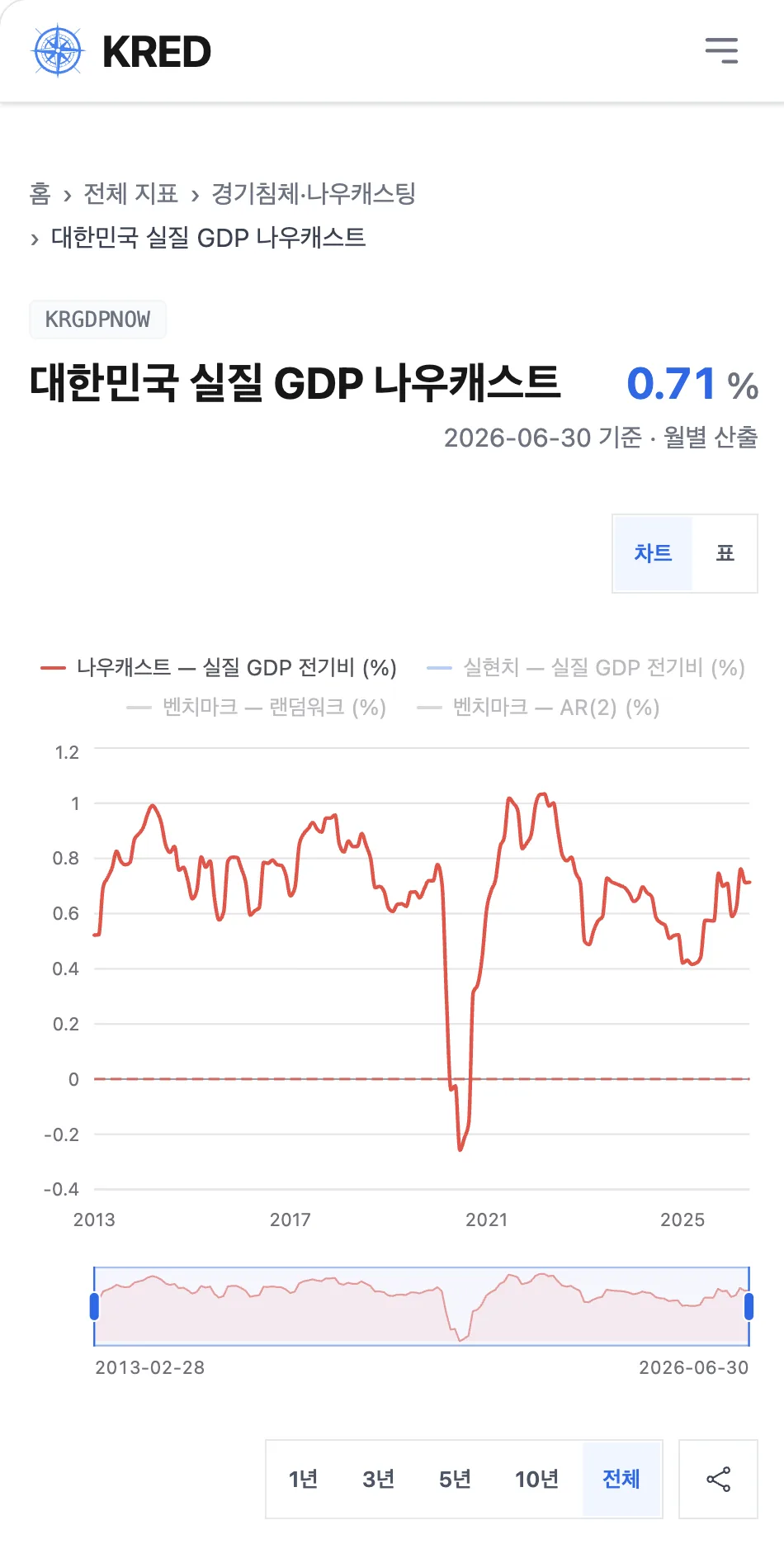
https://kred.dev/en/series/KRGDPNOW
Korea's real-GDP nowcast is printing at levels last seen before COVID.
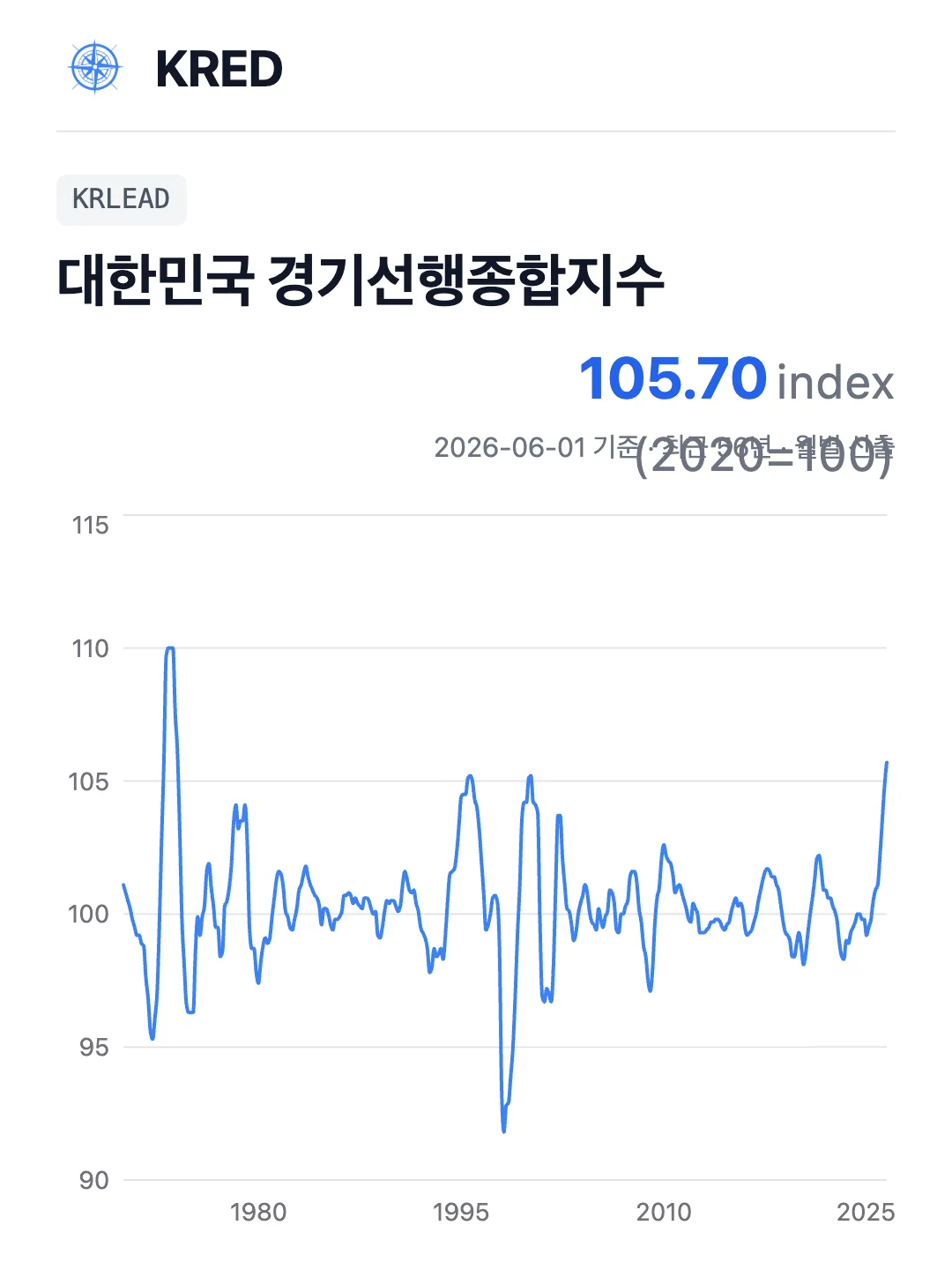
https://kred.dev/en/series/KRLEAD
The Leading Composite Index is at levels last seen in the "three lows" boom of the 1990s.
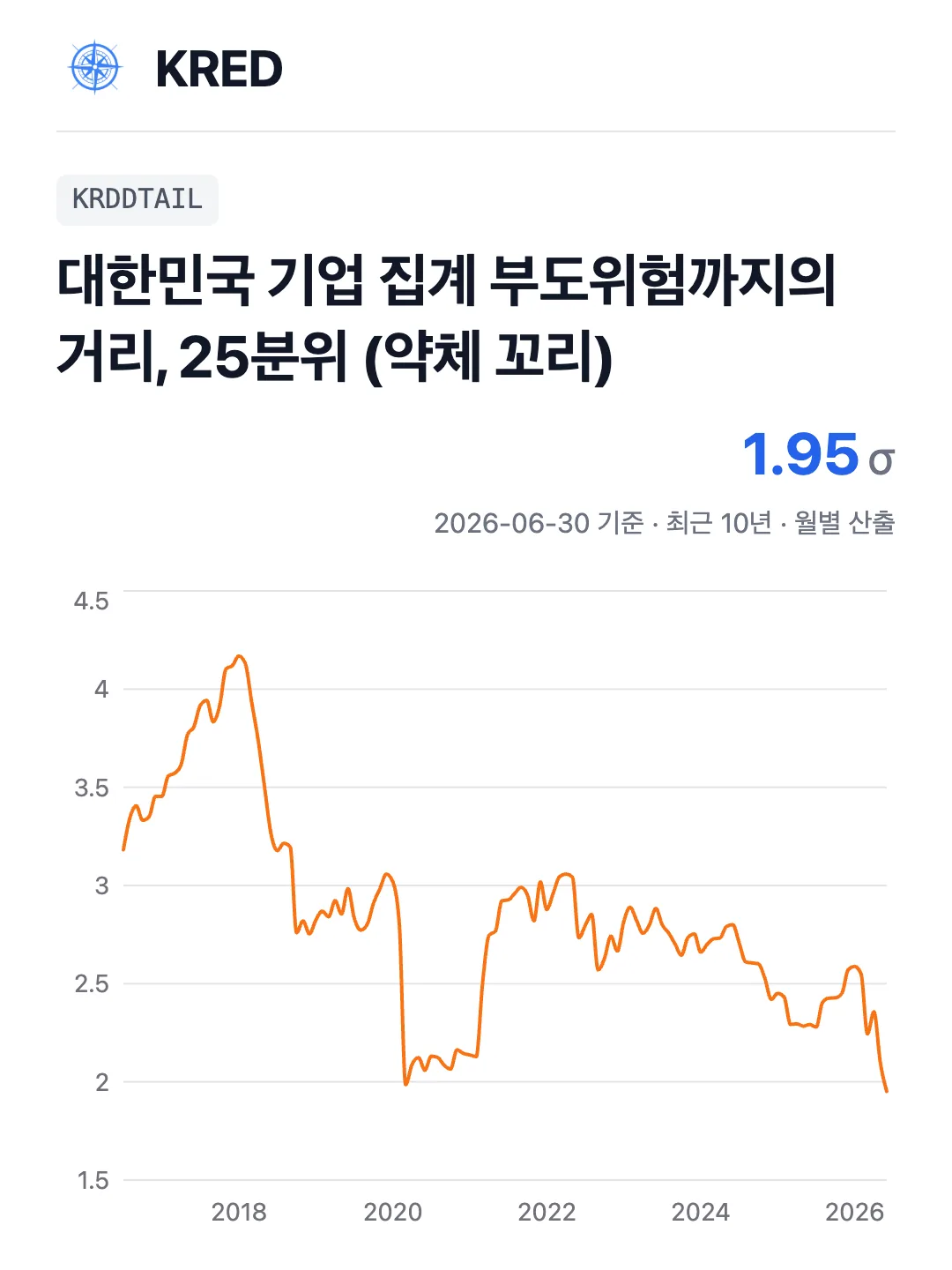
https://kred.dev/en/series/KRDDTAIL
Marginal firms are another story. Among externally audited firms that file financial statements on DART, the Financial Supervisory Service's disclosure system, the default risk of the bottom 25% is running about as high as it did during COVID.
Remarkably, though, domestic demand's contribution to GDP is rebounding, so this time a genuine trickle-down looks to be in prospect.
Employment
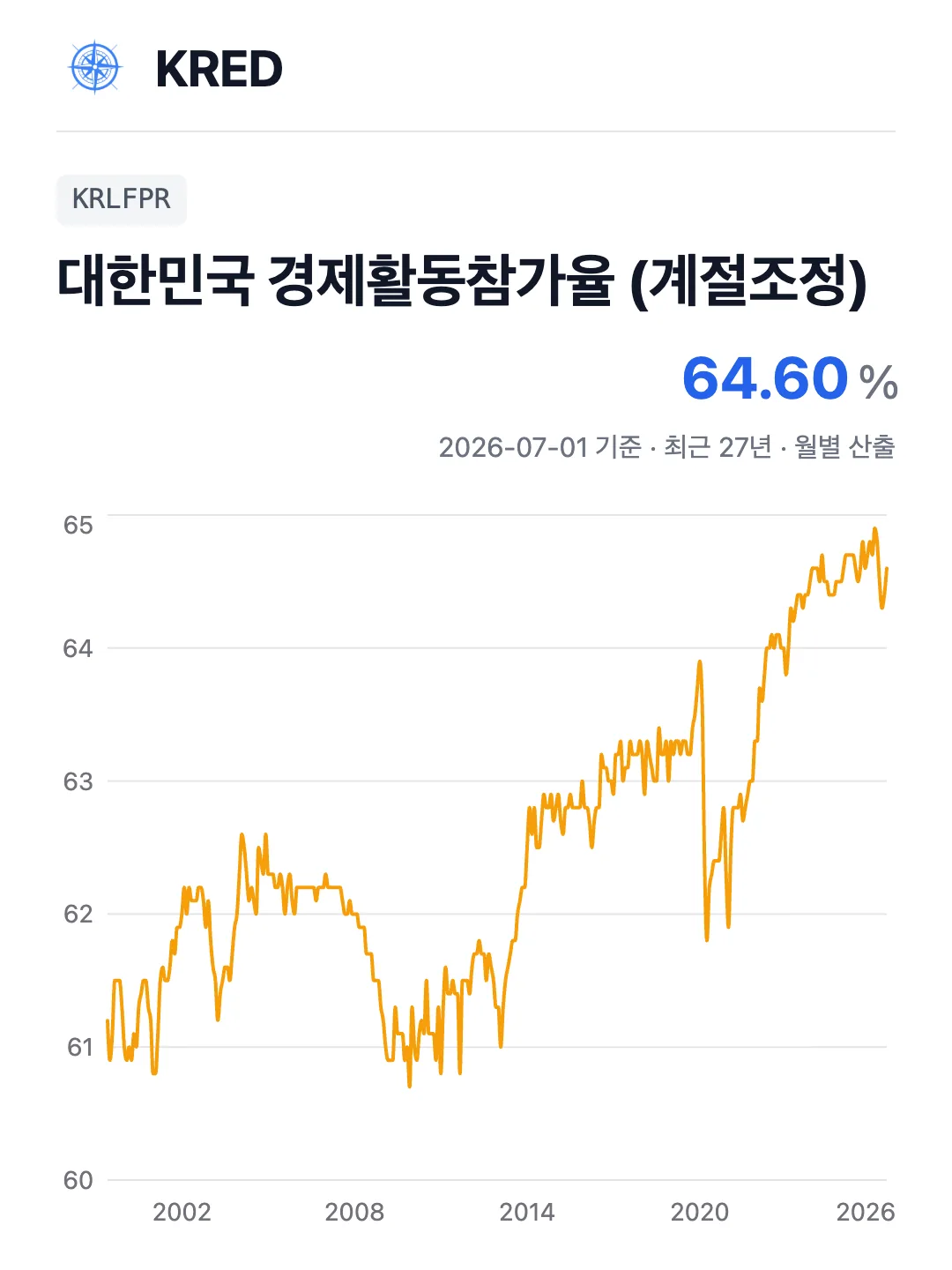
https://kred.dev/en/series/KRLFPR
Korea's labor force participation rate has never been higher.
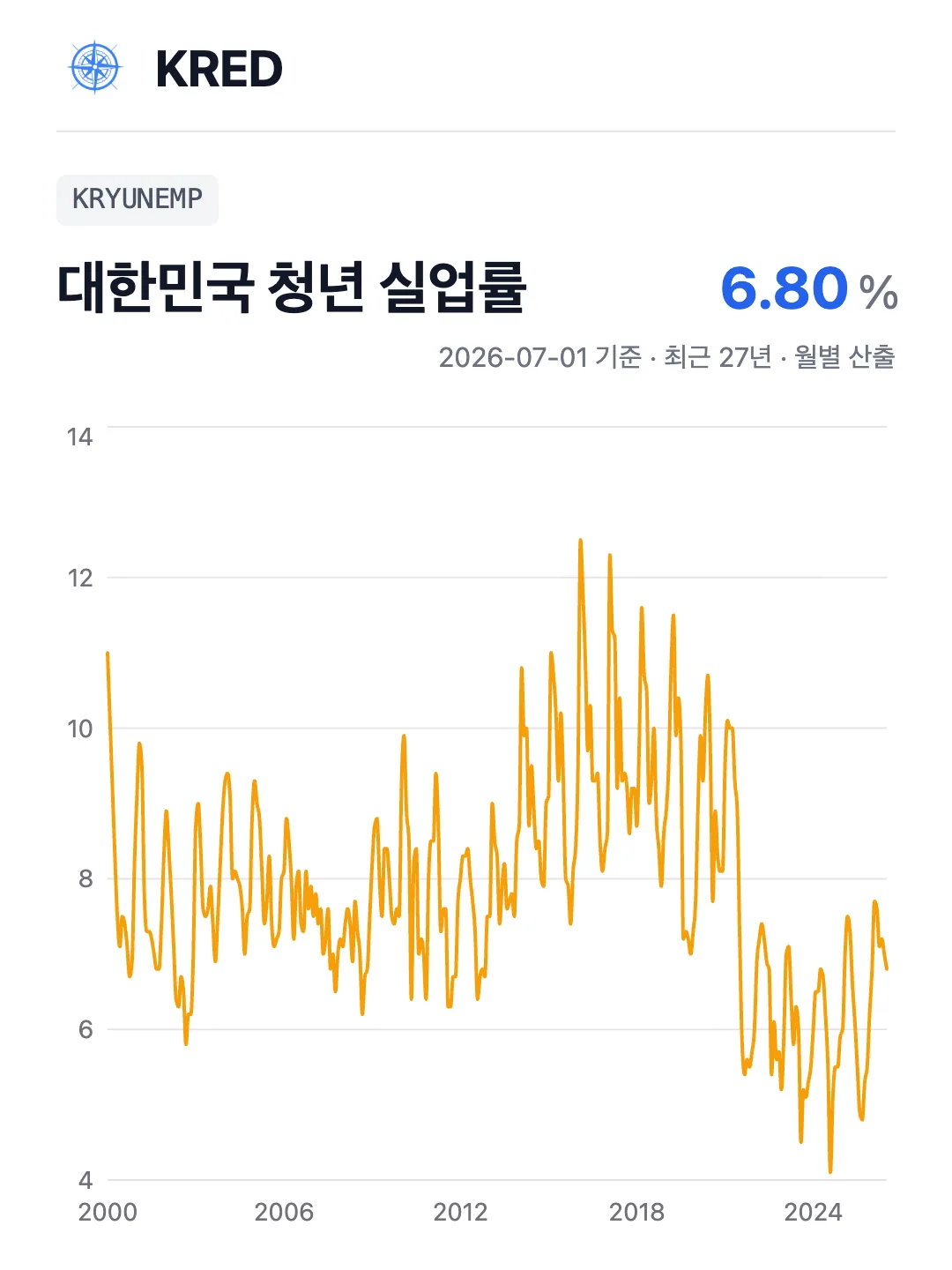
https://kred.dev/en/series/KRYUNEMP
Youth unemployment, though, has yet to return to its pre-COVID level. That poses no immediate problem, but over the long run it is bad for the quality of the labor market.
Reading the Financial Markets
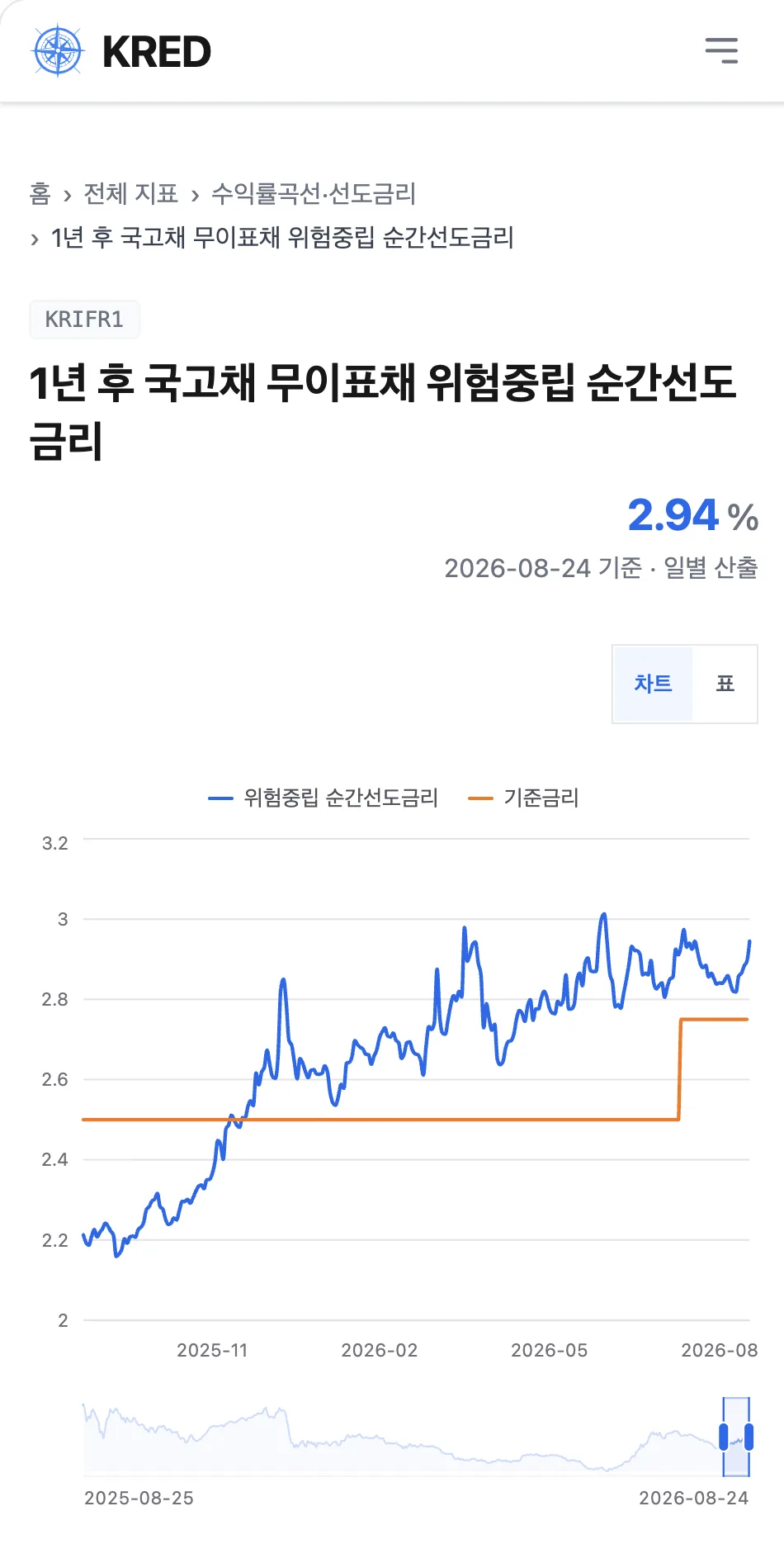
https://kred.dev/en/series/KRIFR1
The one-year-ahead risk-neutral instantaneous forward rate on KTB zeros, that is, the Base Rate that KTB market participants price in for August 24, 2027, stands at 2.94%, which leaves plenty of headroom.
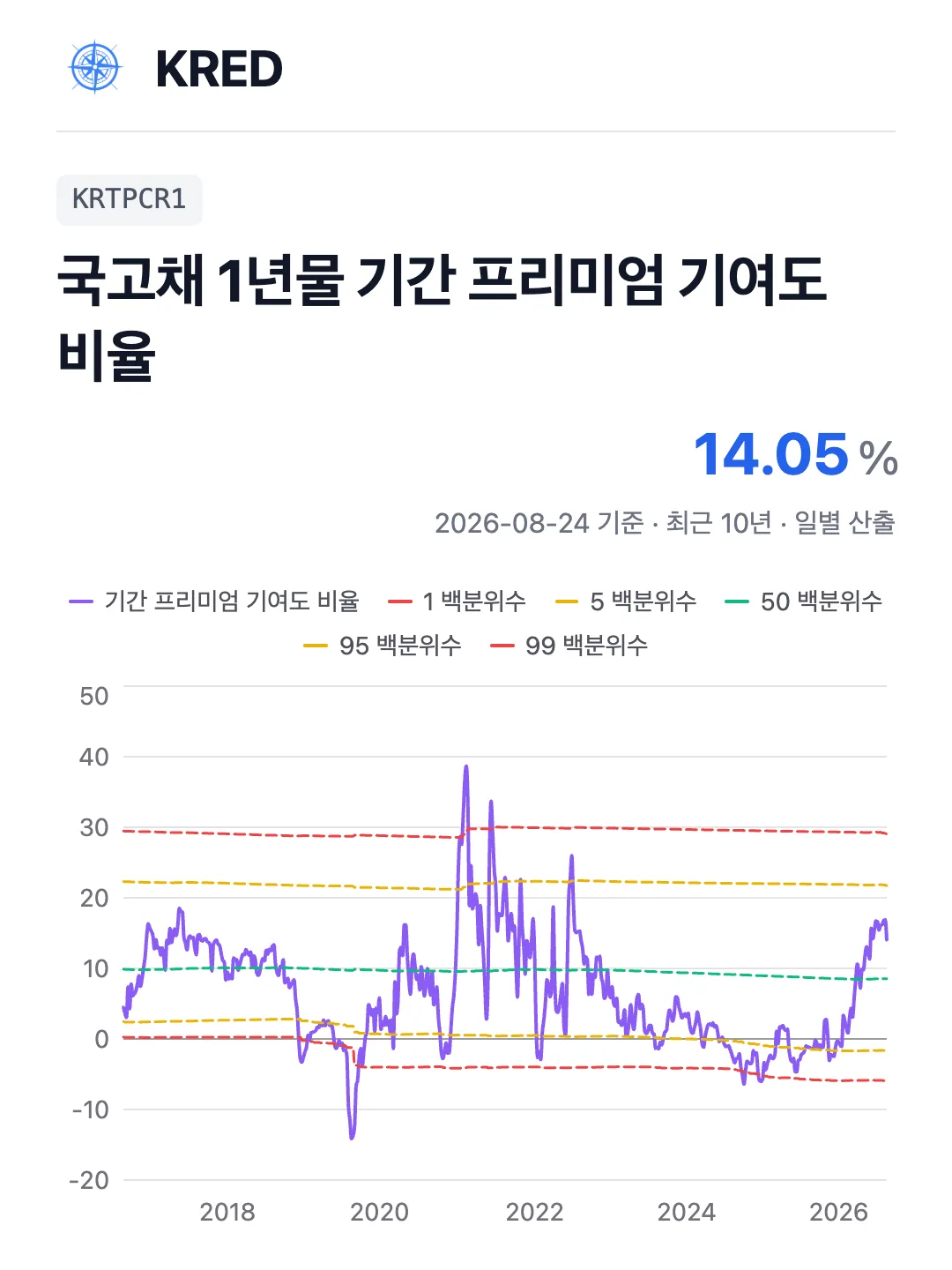
https://kred.dev/en/series/KRTPCR1
The 1-year term premium contribution ratio has likewise come off a near-term peak and is drifting back toward its median. Bond prices, in other words, have put in a near-term bottom (yields a near-term top).
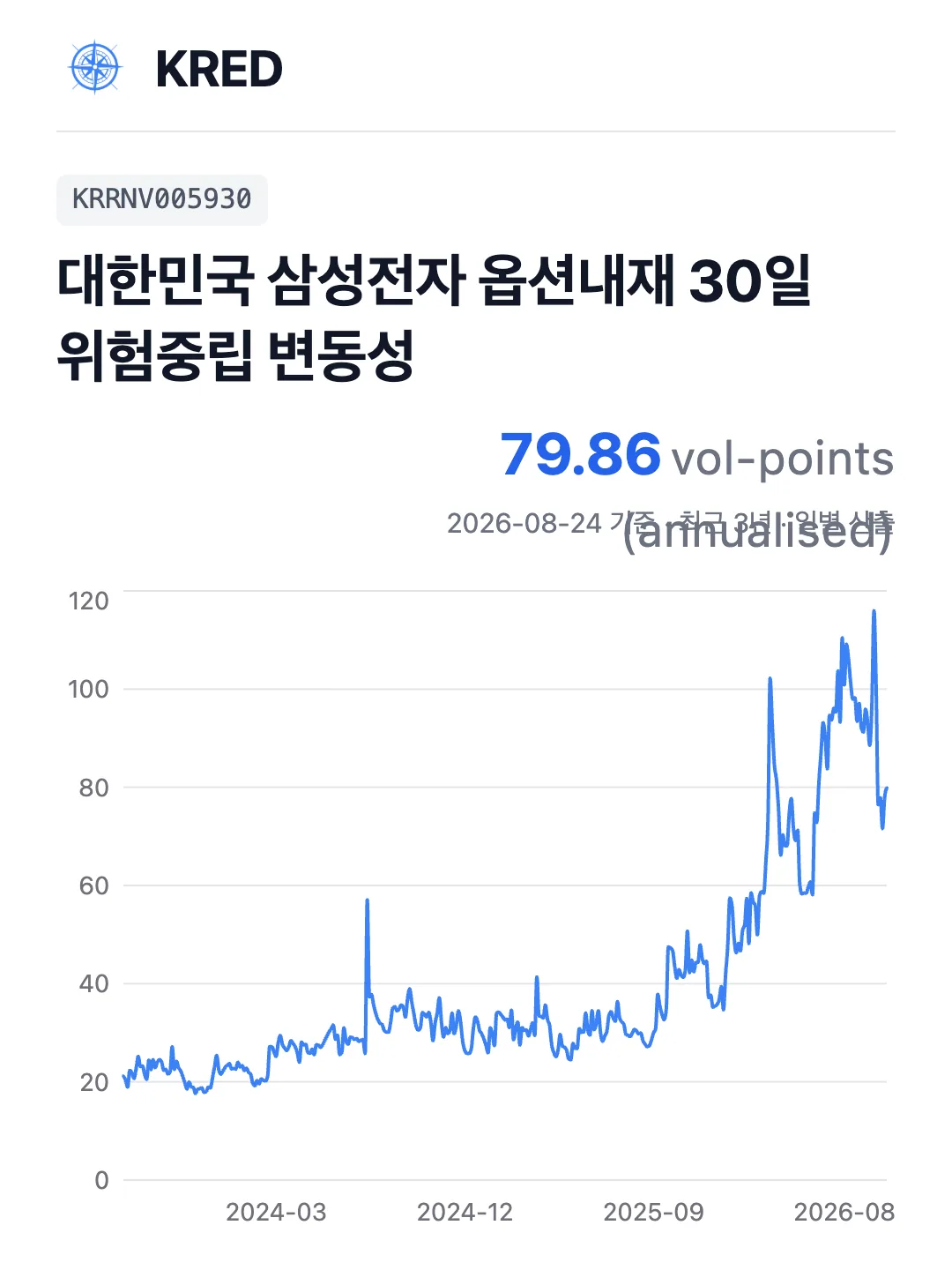
https://kred.dev/en/series/KRRNV005930
Samsung Electronics' option-implied 30-day risk-neutral volatility has also peaked and is coming down, and
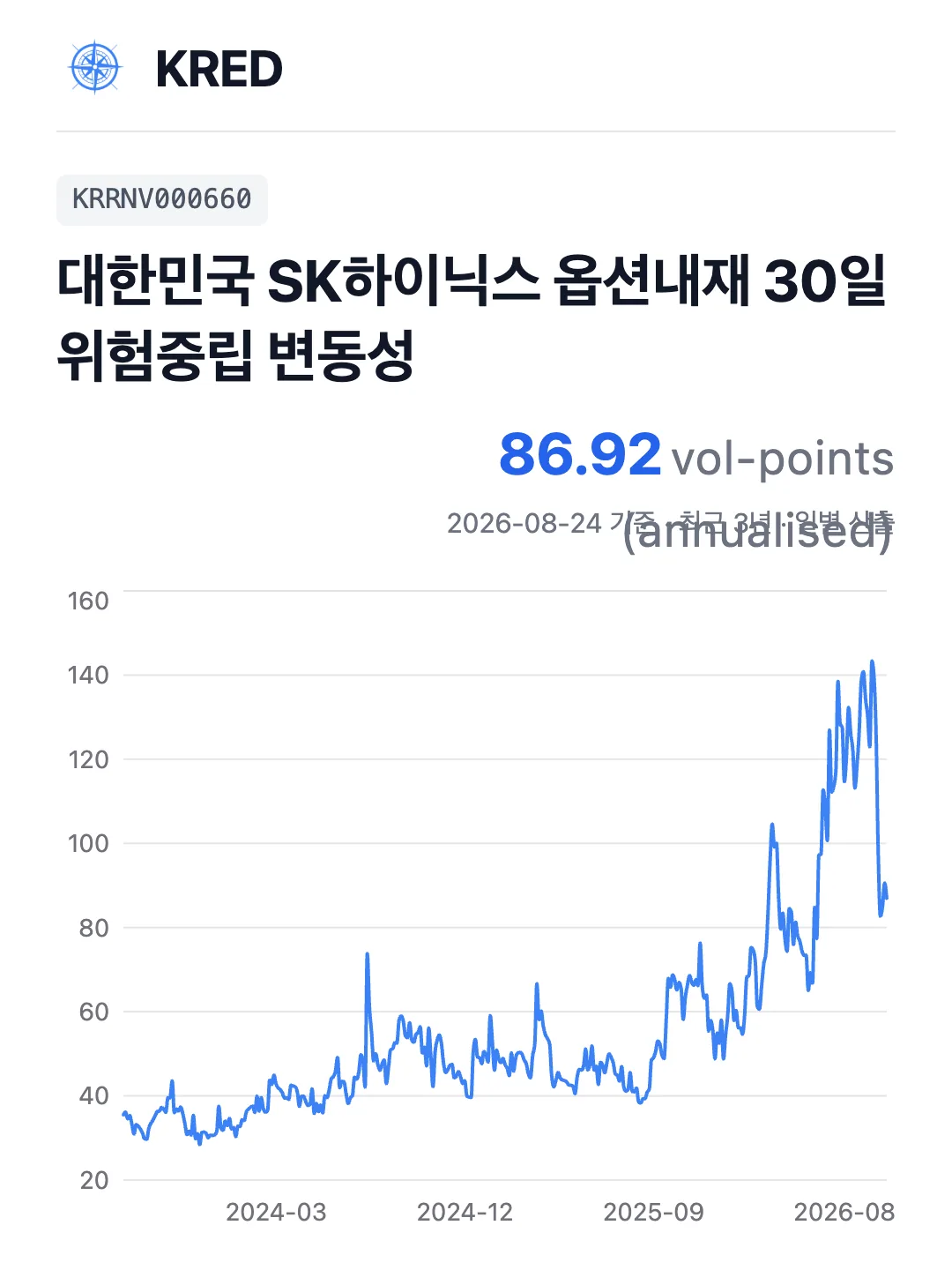
https://kred.dev/en/series/KRRNV000660
SK Hynix's option-implied 30-day risk-neutral volatility shows the same pattern.
If this trend holds, institutional and foreign investors gain room on the Sharpe ratio of Korean semiconductors.
Conclusion
In August, rather than raise the Base Rate, the central bank will pursue price stability by keeping inflation expectations in check.
The Korean economy has fully recovered to its pre-COVID footing and, precariously but surely, is heading toward Goldilocks.
Once it becomes clear that headline inflation will stay under 3%, institutional and foreign investors should return to the equity market, semiconductors first.